Introduction
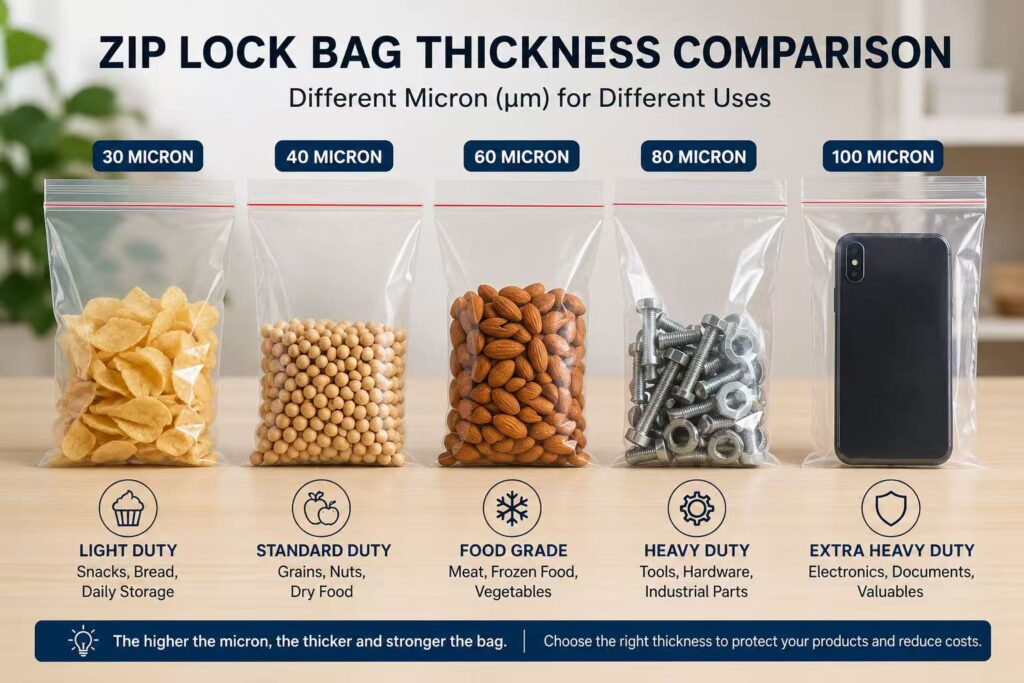
Selecting the correct zip lock bag thickness is a key factor that directly affects packaging performance, product safety, and overall cost control.
Many buyers focus on price or size, but thickness (measured in microns) is what truly determines durability, protection, and user experience.
In this guide, we will explain standard thickness options, real-world applications, and how to choose the most suitable specification for your business.
⸻
What Is “Micron” in Zip Lock Bags?
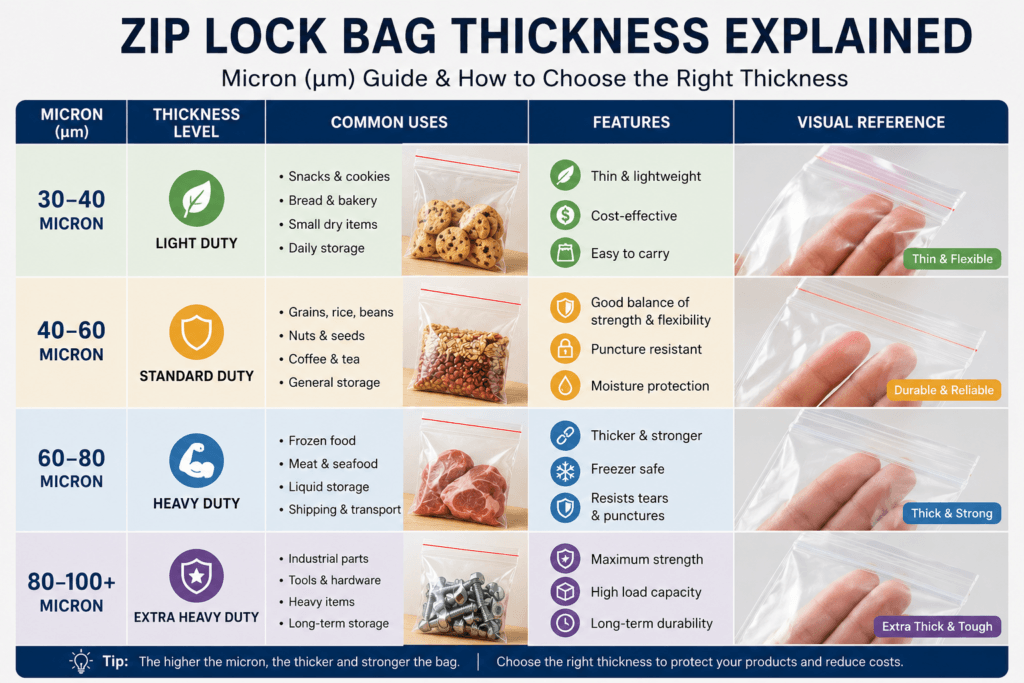
Micron (μm) is the unit used to measure plastic film thickness:
- 1 micron = 0.001 mm
- Higher micron = thicker, stronger material
Typical zip lock bags range from 30 to 120 microns, depending on application requirements.
⸻
Standard Thickness Options & Their Applications
30–40 Micron (Light Duty)
Best for:
- Lightweight food items (snacks, dry goods)
- Small retail packaging
Characteristics:
- Flexible and economical
- Suitable for short-term or low-weight use
- Not recommended for sharp or heavy items
⸻
50–60 Micron (Medium Duty)
Best for:
- Frozen food
- Meat and seafood
- Daily commercial packaging
Characteristics:
- Balanced strength and cost
- Reliable sealing performance
- Most widely used specification in food industry
👉 This is the recommended thickness range for most food packaging applications
⸻
70–100+ Micron (Heavy Duty)
Best for:
- Industrial parts
- Hardware and tools
- Export packaging and long-distance shipping
Characteristics:
- High tensile strength
- Strong puncture resistance
- Suitable for heavy or irregular products
⸻
How to Choose the Right Thickness
- Based on Product Type
- Light items → 30–40 micron
- Food packaging → 40–60 micron
- Industrial goods → 70–100+ micron
⸻
- Based on Application Scenario
Different industries require different performance levels:
- Food → hygiene + flexibility
- Medical → durability + sealing reliability
- Industrial → strength + protection
👉 You can also refer to our application guide for more details.
⸻
- Based on Transportation & Storage
- Local distribution → medium thickness is sufficient
- Export / long-distance shipping → thicker material recommended
⸻
- Based on Cost Optimization
Choosing the thickest option is not always the smartest decision.
The best solution is:
✔ Enough strength for protection
✔ Controlled material cost
✔ Suitable for your market positioning
⸻
Common Mistakes Buyers Should Avoid
❌ Choosing bags that are too thin → risk of tearing or leakage
❌ Choosing bags that are too thick → unnecessary cost increase
❌ Ignoring real application scenarios
⸻
Custom Thickness & OEM Manufacturing
As an experienced zip lock bag manufacturer, we provide customized solutions including:
- Custom thickness (micron range)
- Size and specification adjustment
- Logo printing & branding
- OEM & private label production
We can recommend the most suitable thickness based on your product type, packaging needs, and target market.
⸻
Get Professional Recommendation
If you are unsure which thickness is right for your application, our team can help you select the most cost-effective and reliable solution.
📧 Email: dx429498146@gmail.com
📱 WhatsApp: +86-17771478688
Send us your product details, and we will provide a quick recommendation and quotation.
⸻
Conclusion
Choosing the correct zip lock bag thickness is essential for ensuring product protection, improving packaging efficiency, and controlling costs.
By understanding micron levels and application requirements, you can make more informed purchasing decisions and achieve better results in your packaging process.
⸻